Buyer type
Ready mix concrete companies, contractors, construction equipment dealers and machinery importers comparing HZS model capacity and export support.
Malaysia project configuration
Malaysia projects usually combine high ready mix demand with year-round humidity, heavy rainfall and a confirmed 415 V / 50 Hz site supply, so capacity selection, moisture compensation and port-to-site delivery should be agreed before the quotation is issued.
Ready mix concrete companies, contractors, construction equipment dealers and machinery importers comparing HZS model capacity and export support.
Compare the complete mixer, batcher, silo, weighing, electrical and delivery scope. Final price follows the confirmed destination and border route.
Use factory acceptance, customs inspection, container loading and installation videos to reduce buyer uncertainty before quotation follow-up.
Country project fit
These are engineering discussion baselines. The signed site data, utility schedule and delivery survey control the final quotation.
Malaysia installations normally require a 415 V / 50 Hz three-phase review; motors, control voltage, earthing and protection must follow the confirmed site supply.
Specify rainfall intensity, year-round humidity, corrosion protection, covered aggregate storage, site drainage and real-time aggregate moisture compensation.
Separate ocean freight, port handling, customs clearance, inland haulage and last-mile crane access so the quotation scope stays auditable.
Commercial ready mix, precast production, data centre and industrial park works, roads, bridges, housing, port and warehouse construction.
Confirm early whether the buyer requires CIDB-related or other local documentation, together with import permits and destination-port paperwork, so plant scope, packing list and delivery schedule stay aligned.
Malaysia project scenarios
Data centre, industrial park, precast and ready-mix work each place a different load profile on the batching plant. Confirm the scenario before comparing models, silos and price.
Johor, Cyberjaya and Klang Valley style projects pour continuously in year-round humidity. Review covered aggregate storage, real-time moisture compensation, admixture dosing and a batching record the project quality team can audit batch by batch.
IBS and precast yards usually favour HZS120-HZS180 twin-shaft output for a steady daily mould cycle. Size the silo and cement feed to the casting schedule, then confirm foundation, unloading and commissioning responsibilities before shipment.
Ready-mix suppliers comparing HZS60-HZS90 with HZS120-HZS180 should start from the daily order book, truck dispatch cycle, aggregate sizes and the confirmed 415 V / 50 Hz site supply, not from a headline capacity number.
For projects in Sabah and Sarawak, plan the Port Klang, Penang or Pasir Gudang transfer, onward shipping, crane capacity at the final port and last-mile road access so the freight scope stays inside the quotation.
The East Coast Rail Link runs 665 km from Kota Bharu to Port Klang, with the first phase to Gombak at 95% progress and targeted for completion in December 2026 and the Gombak to Port Klang section following through 2027. Track slab, sleeper, bridge and station work is spread along the alignment, so concrete comes from casting yards and batching points that move with the works. Review the plant footprint for a yard that relocates, covered aggregate storage for year-round rain, admixture dosing to the approved mix design, and a batching record the project quality team can audit batch by batch.
Send state and city, destination port (Port Klang, Penang or Pasir Gudang), required output, confirmed voltage/frequency, aggregate condition, import registration status and installation schedule.
Export delivery videos
Inspection and document checkpoints to review before export shipment.
Loading protection, flatbed transport and container departure planning points.
| Model | Capacity | Mixer | Batcher | Typical buyer | Reference | |
|---|---|---|---|---|---|---|
| HZS25 | 25 m3/h | JS500 | PLD800 | small contractors, rural roads and compact jobsites | $62,000+ | Ask Price |
| HZS35 | 35 m3/h | JS750 | PLD1200 | building contractors and municipal maintenance | $80,000+ | Ask Price |
| HZS50 | 50 m3/h | JS1000 | PLD1600 | medium construction projects and precast supply | $109,000+ | Ask Price |
| HZS60 | 60 m3/h | JS1000 | PLD1600 | ready-mix startups and contractors needing stable output | $110,000+ | Ask Price |
| HZS75 | 75 m3/h | JS1500 | PLD2400 | commercial concrete suppliers and bridge projects | $122,000+ | Ask Price |
| HZS90 | 90 m3/h | JS1500 | PLD2400 | large contractors and infrastructure projects | $126,000+ | Ask Price |
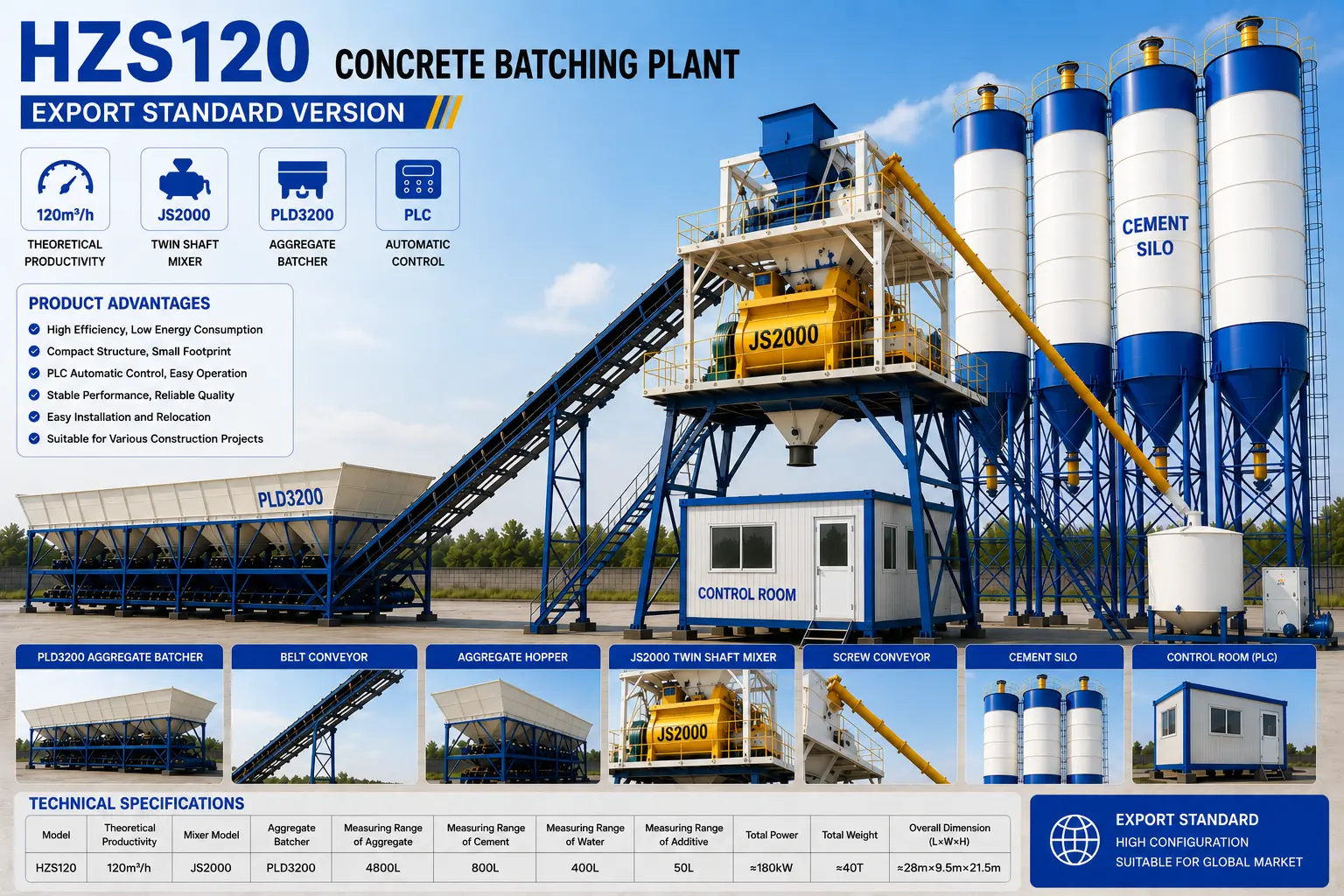
| HZS120 | 120 m3/h | JS2000 | PLD3200 | high-output ready-mix plants | $168,000+ | Ask Price |
| HZS180 | 180 m3/h | JS3000 | PLD4800 | major infrastructure and city concrete supply | $238,000+ | Ask Price |
| HZS240 | 240 m3/h | JS4000 | PLD5600 | large commercial concrete production bases | $320,000+ | Ask Price |
FAQ
HZS60-HZS90 fit contractor and regional projects; HZS120-HZS180 support commercial ready mix, precast and larger industrial or infrastructure supply.
Confirm Port Klang, Penang or Pasir Gudang as the destination port, inland haulage to site, unloading crane capacity and road access before freight is quoted.
Use a practical price anchor based on capacity and scope, then confirm mixer, aggregate batcher, cement silo, control system, spare parts and shipment details before final factory quotation.
Data centre work is concrete-heavy at the front end: large mat and raft pours, heavy structural and precast elements, and tight pour windows on congested sites. Specify from the pour schedule and the concrete volume per day rather than the project's headline capacity. An HZS90-HZS180 twin-shaft plant with enough silo and aggregate storage to hold one continuous pour is the usual starting point, with bulk cement delivery cadence, admixture dosing and a covered aggregate yard confirmed before the model is fixed.
Public reporting through 2026 describes the build-out shifting from announcements into real construction activity, with power availability, water and funding as the binding constraints rather than concrete demand. Two checks follow for a plant order: confirm the site's connected load and whether a generator-duty electrical package is needed, and confirm the water supply or reclaiming arrangement for the batching area. Both change the electrical and civil scope rather than the plant model, and the site supply should be confirmed at 415 V / 50 Hz before the electrical package is signed off.
The extension is still a proposal agreed at government level in September 2026, running from Kota Bharu to the Thai border town of Rantau Panjang; further talks come before any Cabinet decision, so treat it as a corridor to watch rather than an awarded package. The ECRL under construction is 665 km from Kota Bharu to Port Klang with 20 stations, and the first section has been targeted to open from December 2026, with the Gombak to Port Klang phase completing later and full operations targeted for January 2028. Rail corridor concrete is spread out rather than concentrated in one big pour: track slab and ballast works, precast sleepers, station structures and bridges, each with its own window. Corridor packages are therefore usually sized on daily volume and haul distance: an HZS60-HZS90 twin-shaft plant with covered aggregate storage for the wet equatorial season and a 415 V / 50 Hz electrical package covers station and bridge works, moving up to HZS120 where several frontages pour at the same time.
Malaysia's Budget 2027 will be tabled on 9 October 2026, and market consensus puts development expenditure at RM85 billion to RM90 billion, with construction and building materials among the sectors expected to benefit. Ahead of the tabling, the Works Ministry asked for a higher allocation than 2026 and proposed six construction-sector agendas covering road networks and high-impact projects, sustainable development under the National Energy Transition Roadmap, digitalisation and Industry 4.0, developing local capacity and road safety through MYJalan, and better regulation and human capital. Industry players at the same dialogue raised material, operating, labour and taxation costs, while the ministry said official statistics show material price increases below one per cent. Nothing is committed until the budget speech and the agency work programmes follow, so plan from the award rather than from the announcement: confirm whether your package sits in the 2026 or the 2027 cycle, then set production, shipment and commissioning dates so the plant runs before the first continuous pour. Smaller packages generally suit a compact HZS25-HZS60 plant; larger packages with several frontages move to HZS90-HZS180, and the 415 V / 50 Hz supply should be confirmed before the electrical package is fixed.
MIDA put RM385.7 billion of data-centre-related investment on record for 2021 to the first half of 2026, with data centre and cloud projects accounting for RM95.8 billion, close to 44 percent of all approved investment in that half-year, and the largest concentrations in Greater Kuala Lumpur and Johor. The agency's stated next phase shifts from attracting investment to building local capability, and the Data Centre Task Force now clears only projects with secured power and water and demonstrable green compliance, prioritising operators that support the local supply chain. For concrete, the practical consequence is sequencing: campus demand starts with site preparation, haul roads, backfill and mat or raft foundations, ahead of the data halls themselves, while power and water availability can gate the civil programme more than the pour volume does. Ask for the civil works programme and the pour windows inside a live campus before fixing the model: an HZS90-HZS180 twin-shaft plant with covered aggregate storage and a 415 V / 50 Hz electrical package covers most campus frontages, and for Malaysian contractors the local-vendor route is the one the task force says it prioritises.
Malaysia installations normally require a 415 V / 50 Hz three-phase review; motors, control voltage, earthing and protection must follow the confirmed site supply.
Specify rainfall intensity, year-round humidity, corrosion protection, covered aggregate storage, site drainage and real-time aggregate moisture compensation. Separate ocean freight, port handling, customs clearance, inland haulage and last-mile crane access so the quotation scope stays auditable.